Learning the Red Scales: Scales Starting on Open Strings
If you haven’t, check out the Scale Introduction post so you have a handle on the terminology discussed here.
Starting the Major Scales
The first scales we’ll cover are those that start on the open strings. For the Finger Patterns we worked small scales that stay on one string. For the octave scales we put two strings together.
How to Play the D Major Scale
To start with we’re going to split the scale in half. We start on the open D string and play the 1st, 2nd, and 3rd fingers. Then we switch to the A string and do the same thing. This gives us a stepwise sequence of eight notes. Practice this until it is really smooth. Sometimes switching the strings can be tricky at first because our brains see it as a completely new activity. Work until that isn’t the case anymore and all eight notes flow nicely.
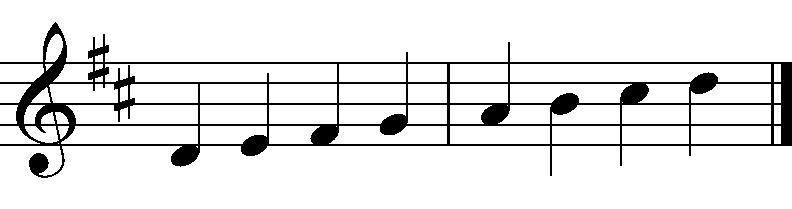
To come down the scale we are going to make a change. It is very common to play open strings on the way up a scale, but do the 4th finger on the way down. So from the top play 3rd, 2nd, 1st, then shift over to the D string to play the 4th finger A. This can take some getting used to, but see this post for a very in depth method for drilling this [insert link]. Continue down to play the open string. We don’t do a 4th finger on the bottom because we don’t want to cross strings for one single note.

Spend plenty of time working the descending scale, making sure that each note moves smoothly to the next. Once that’s comfortable, combine it with the ascending one to play the full scale.

Adding the D Major Arpeggio
Arpeggios go with scales because they are both extremely common patterns. The arpeggio is what we call a broken chord. Chords make up the basis for harmony in music. An instrument like the piano can easily play all four notes of a chord at once, but because it’s harder for violins to do so we play arpeggios; the same notes of the chord, just one at a time.
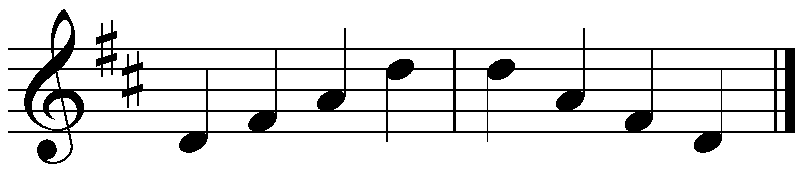
The formula to play an arpeggio is skip-skip-tonic. Tonic is the main note of the scale/arpeggio/key we are playing. For a D Major scale the tonic is D. So we start with the open D string, then skip to F-sharp. We skip again to A. We then make a leap to the top tonic (3rd finger D on the A string). Then to come back down we just reverse that pattern.
How to Play the A Major Scale
Now do exactly what you did to play the D Major scale and arpeggio, but start on the A string. That’s how you play the A Major scale.

What happened is we moved the set of half and whole steps to a new place. This created a new set of notes that have the same structure as the D Major scale. This is called transposition. It’s also what happens when we play the Finger Pattern exercises on all the strings. We are transposing the pattern. That’s what makes a major scale sound like a major scale; the same patterns starting on different tonic notes.
How to Play the G Major Scale
To play the G Major scale we do the same thing but start on the G string. It’s that easy.

Those are the three Red Pattern scales
What About the E String?
There is not a Red Pattern E Major scale because we would need a string above E to play it. The scales require at least two strings to play without some advanced techniques we don’t learn right away.
Once you have the A Major scale comfortable go back to the finger pattern exercises and really get used to the Blue Pattern in order to prepare for those scales.